Find all that relate to naruto. supply of ninja, story, video of game,DVD,Walppaer,story and all that relate to naruto. see and buy, feel its amenity because this web always renewed each every moment.

Akamaru


Country: Fire Country; Hidden Leaf Village
Age: 3 Height: 28 CM Weight: 5.1 KG
Birthday: February 2nd
Bloodtype: Canine
First Seen: Chapter 039; Anime Episode 034
Acquaintances: Inuzuka Kiba
read more...

privacy statment

What follows is the Privacy Statement for all book naruto including all the blogs run under the http://booknaruto.blogspot.com domain.
Please read this statement regarding our blogs. If you have questions please ask us via our email address : my.super.media[at]gmail.com
Email Addresses
You may choose to add your email address to our contact list via email on our blogs. We agree that we will never share you email with any third party and that we will remove your email at your request. We don’t currently send advertising via email, but in the future our email may contain advertisements and we may send dedicated email messages from our advertisers without revealing your email addresses to them. If you have any problem removing your email address please contact us via our email.
Ownership of Information
book naruto is the sole owner of any information collected on our websites.
Comments/Message Boards
Most book naruto Blogs contain comment sections. We do not actively monitor these comments and the information on them is for entertainment purposes only. If we are alerted to something we deem inappropriate in any way, we may delete it at our discretion. We use email validation on most of our comment sections in order to reduce “comment spam.” These email addresses will not be shared with any third party.
Cookies
Currently we assign cookies to our readers in order to save their preferences. This data is not shared with any third party. Accessing our websites is not dependent on accepting cookies and all major browsers allow you to disable cookies if you wish.
Third Party Cookies
Many of our advertisers use cookies in order to determine the number of times you have seen an advertisement. This is done to limit the number times you are shown the same advertisement. book naruto does not have access to this data.
Traffic Reports
Our industry-standard traffic reporting records IP addresses, Internet service provider information, referrer strings, browser types and the date and time pages are loaded. We use this information in the aggregate only to provide traffic statistics to advertisers and to figure out which features and editorials are most popular.
Legal proceedings
We will make every effort to preserve user privacy but book naruto may need to disclose information when required by law.
Business Transitions
If book naruto is acquired by or merges with another firm, the assets of our websites, including personal information, will likely be transferred to the new firm.
Links
Book naruto blogs frequently link to other websites. We are not responsible for the content or business practices of these blogs. When you leave our blogs we encourage you to read the destination site’s privacy policy. This privacy statement applies solely to information collected by Book Naruto
Notification of Changes
When Book Naruto makes changes to this privacy policy we will post those changes here.
Contact Information
If you have any questions regarding our privacy policy, please contact us.
Best regards,
Book Naruto
read more...

Aburame Shino


Country: Fire Country; Hidden Leaf Village
Age: 13 Height: 161.1 CM Weight: 48.5 KG
Birthday: January 23rd
Bloodtype: AB
First Seen: Chapter 034; Anime Episode 001
Acquaintances: Aburame Shibi, Hyuuga Hinata, Inuzuka Kiba, Yuuhi Kurenai
read more...

Naruto Manga Chapter 442


Well, there was not an episode from the Naruto: Shippuuden anime series to keep us entertained as we wait for the manga (there will be a double header next week, though, as both the 103rd and 104th episodes will be released!), but at the very least... we do get the manga! Chapter 442 of the series entitled: The Last Gamble!! - has been released translated in to English, and can be given a read by absolutely anybody who wants it for absolutely nothing at all! All you need to do is simply click on over to
read more...

Team 7


Naruto has a large number of characters, most of whom are ninjas. They initially study at the Ninja Academy, where the story begins, are split up into squads of three after their graduation and become Genin, rookie ninja. Each squad is assigned an experienced sensei.[1] These core squads form a basis for the characters' interactions later in the series, where characters are chosen for missions for their team's strength and complementary skills; Naruto's squad 7 becomes the social frame where Naruto is acquainted with Sasuke Uchiha, Sakura Haruno, and their sensei Kakashi Hatake, forming the core of his world-in-the-making. The other three-man teams of his former classmates form another such layer, as Naruto connects with them to various degrees, learning of their motives, vulnerabilities, and aspirations. The groups of three are not limited to the comrades Naruto's age – groups in the story in general come in threes and multiples of three.[2]

In the Naruto world, countries operate as separate political entities ruled by landlords. Within these countries are hidden villages (隠れ里 ,kakurezato?), settlements housing ninja, warriors capable of using supernatural abilities in combat. A hidden village maintains the economy of the parent country by training ninja from a young age and using them to perform missions for other countries. The ninja of a hidden village also serve as the military force of their parent country. The leaders of the hidden villages hold equal status with the leaders of their respective countries. Five countries in the Naruto world—the Land of Earth, the Land of Fire, the Land of Lightning, the Land of Water, and the Land of Wind—are known as the "Five Great Shinobi Nations". These countries are the most powerful in the Naruto world. They are ruled by a feudal lord, and the leaders of the hidden villages in these countries hold the title of Kage. Other apparently smaller nations have been named in passing, in either the manga or anime, but are yet to be explored.[3]
read more...

Jiraiya


Profile
Age 50-51 in Part I
54 in Part II
Date of birth November 11

Jiraiya is a fictional character in the Naruto universe created by Masashi Kishimoto.

Jiraiya is named after the character of the same name from Jiraiya Goketsu Monogatari , “The Tale of the Gallant Jiraiya”). The Jiraiya in this story excelled in summoning a giant toad (the toad itself was sometimes called “Jiraiya”) and toad magic. In that story, Jiraiya and Tsunade were a married couple. There, his name is written as “児雷也” meaning “Young Thunder” which in turn comes from the name Garaiya (我来也, “I came”) from the Chinese story Kaishi (諧史).

Masashi Kishimoto originally planned to draw Jiraiya with a different design and with a different style of hair. He also intended for Jiraiya to summon Toads that were of a similar size to humans. However, this idea was deemed a failure. During an interview, he comments that, of the student-teacher relationships in Naruto, Jiraiya and Naruto’s is the one he likes the most.

Jiraiya grew up in the village of Konohagakure under the tutelage of the Third Hokage. As he grew older Jiraiya and his two teammates, Orochimaru and Tsunade, collectively became known as the “Legendary Three Ninja” (伝説の三忍 ,Densetsu no Sannin) due to their exemplary ninja abilities. For most of his adult life, and thus many of his appearances in the series, Jiraiya periodically leaves his hometown to explore the Naruto world. Although he spends comparatively little time in Konoha, Jiraiya maintains a deep loyalty to the village; soon after his introduction, he makes clear his intentions to kill Tsunade if she should ever turn against Konoha despite their history together. Throughout the series Jiraiya’s talents and dedication to the village lead to him being offered the position of Hokage, Konoha’s protector. Because of his perceived weaknesses (his inability to keep Orochimaru from becoming a criminal and his failure to protect his teacher and his student from dying in their own tenure as Hokage) Jiraiya always declines the offer, feeling that he is unworthy of the responsibility.

Jiraiya is a self-proclaimed super-pervert with no equal. During many of his appearances he makes at least one attempt to either hit on women or spy on them while they bathe. While Jiraiya makes no attempt to hide these habits, going so far as to brag about his talents with voyeurism, he gets irritated whenever series protagonist Naruto Uzumaki affectionately calls him “Pervy Sage” (エロ仙人 ,Ero-sennin). His interest in women has on occasion been his downfall; sometime in the past he tried spying on Tsunade, and was subsequently nearly fatally wounded when she caught him in the act. Jiraiya’s experiences in love, particularly those with Tsunade, are recorded in his Make Out (イチャイチャ ,Icha Icha) series of novels. The books, a favorite of Kakashi Hatake, are runaway best-sellers within the Naruto world and have earned Jiraiya a vast wealth. Before penning the Make Out series Jiraiya published a sort of autobiography where the main character was named “Naruto.” Despite the book’s poor sales Minato Namikaze, Jiraiya’s student, named his son after the main character in the hopes that he would grow up to be just like the Naruto in the book, subsequently naming Jiraiya Naruto’s godfather.

Across the Naruto world Jiraiya is known as the “Toad Sage” (蝦蟇仙人 ,Gama Sennin). Having been trained by toads to utilize their secret arts, Jiraiya can summon them to his side as allies during battle. If need be, he can also summon parts of toads, on one occasion blanketing an area with a toad’s esophagus to immobilize and trap an opponent. In the second half of the series, around the time of his death, Jiraiya is shown to possess a number of toad-based abilities not wholly reliant on summoning. Most prominent of these is being able to enter “Sage Mode” (仙人モード ,Sennin mōdo), a transformation that drastically increases his physical abilities and the strength of his attacks. Despite the advantages the form allows him, he does not like entering Sage Mode; the transformation gives him a bulbous nose, webbed hands, and a number of warts, all of which make him unappealing to girls.

While toads make up the bulk of his ninja abilities, Jiraiya displays a variety of miscellaneous talents throughout the series. He can breathe fire, create swamps to immobilize enemies, and grow and sharpen his hair for both offensive and defensive purposes. He was taught how to use the Rasengan by Minato, which Jiraiya in turn teaches to Minato’s son, Naruto Uzumaki, shortly after his introduction. At various times in the series Jiraiya has been shown to be knowledgeable with seals. This expertise most commonly comes to light in relation to the nine-tailed demon fox sealed within Naruto’s body, a force Jiraiya constantly tries to help Naruto gain control of.

Jiraiya makes only sporadic appearances for most of the series, returning to Konoha after long absences to report on information he has learned during his travels. Initially this information concerns Orochimaru’s continued efforts to destroy Konoha, though as the series progresses he also begins reporting on the criminal organization, Akatsuki. During some of his returns Jiraiya takes the time to train Naruto, teaching him his own signature abilities and how to control the nine-tailed demon fox sealed within him. His training with Naruto marks the gap between Part I and Part II of the series, wherein Jiraiya takes him away for two-and-a-half years.

In Part II, Jiraiya begins investigating the leader of Akatsuki, Pain. In the course of his investigation he is drawn into battle with Pain, a fight that spans most of Naruto manga volume forty-one. During this volume parts of Jiraiya’s background are explored. While he trained with the toads a prophecy concerning Jiraiya was made: that he would someday have a student with the power to save or destroy the world. Several years later he met Nagato, a boy Jiraiya assumed to be the subject of the prophecy and thus trained him to be the world’s savior. Believing Pain to be the very same child he trained and thought to have died, Jiraiya tries to kill his student to prevent the world’s destruction before being overwhelmed by the Six Paths. At the battle’s conclusion Jiraiya realizes that he was mistaken; Naruto was actually the boy foretold in the prophecy. Before he is subcumbing to his fatal wounds, Jiraiya sends the secret behind Pain’s Paths and identity to Naruto and the rest of Konoha, dying without regret that did all he could for the future hero of the world.

Jiraiya is a playable character in most Naruto video games, including the Clash of Ninja series and the Ultimate Ninja series. In the first game of the Ultimate Ninja series he only appears as a support to Naruto during his special techniques. Since Ultimate Ninja 2 he is an available character and has been given variations of the Rasengan, fire techniques and toads summoning techniques. Naruto Shippūden: Gekitou Ninja Taisen EX marks the first appearance of Jiraiya in a video game set in Part II, with the second one being Naruto Shippūden: Narutimate Accel. Jiraiya only appears in the third original video animation but he does not take a big role. Jiraiya makes an appearance so far in only one Naruto film, Naruto Shippūden 2: Bonds.

Jiraiya has appeared in several of the main Shonen Jump popularity polls. In the second and third he ranked in the top ten. In the fourth poll he ranked at 11th. Merchandise based on Jiraiya has also been released, including key chains, action figures, and his headband.

Several publications for manga, anime, video games, and other related media have provided praise and criticism on Jiraiya’s character. DVDTimes praised the character as the greatest character Masashi Kishimoto has ever created in this series. They note that besides the fact he fills the comical pervert archetype he is one of the strongest characters in the series and just about everything about him is rough and unpredictable. Activeanime remarked Jiraiya’s training with Naruto as good comic relief and noted how similar are both of these characters. Animeondvd also praises Jiraiya’s introduction in the series noting him to be a very funny character. IGN commented on his relationships with Naruto Uzumaki that “they share so much in common”.
read more...

Gaara


Profile
Age 12-13 in Part I
15-16 in Part II
Date of birth January 19
Notable relatives Temari (sister)
Kankuro (brother)
Ninja rank Genin in Part I
Fifth Kazekage in Part II
Ninja team Sand Siblings in Part I

Gaara is a fictional character in the Naruto manga and anime series created by Masashi Kishimoto. Kishimoto designed Gaara as a foil to the series’ titular character, Naruto Uzumaki, as the two were born through similar circumstances, but develop vastly different personalities as they deal with their troubled upbringing. Initially introduced as an antagonist and Naruto’s rival, the two eventually develop a bond as kindred spirits and become close friends as the series progresses.

In the anime and manga, Gaara is a ninja affiliated with Sunagakure, and is the son of Sunagakure’s leader, the Fourth Kazekage. As a child, his father attempted to turn him into a human weapon by placing a tailed beast into him, and he was ostracized by the Sunagakure villagers. As a result, he develops into a ruthless killer, slaying others without remorse, and treating his siblings Kankuro and Temari with contempt. His battle with Naruto during the series changes this outlook, and he begins to aid others in order to emulate Naruto. In Part II of the series, he becomes Sunagakure’s Fifth Kazekage. Gaara has appeared in several pieces of Naruto media, including the second featured film in the series, the third original video animation, and several video games.

Numerous anime and manga publications have commented on Gaara’s character. IGN labeled the disparity between Naruto and Gaara as “emotional” and “a tad creepy”. Anime News Network called Naruto’s fight against Gaara the high point of the entire series. Among the Naruto reader base, Gaara has been popular, placing high in several popularity polls. Numerous pieces of merchandise have been released in Gaara’s likeness, including plush dolls and key chains.

Naruto author Masashi Kishimoto created Gaara as a foil to the series’ protagonist, Naruto Uzumaki. He and Naruto have a similar background: he was rejected by his peers and fellow villagers for being the host of a tailed beast, Shukaku, a situation that Kishimoto describes as “very much like Naruto’s”. Gaara’s development from this state into a highly withdrawn, sadistic character was intended to induce sympathy for him from readers, as it was contrasted against Naruto’s development into a cheerful troublemaker.

Gaara’s initial attire, along with the costumes of his siblings, were difficult for Kishimoto to draw on a weekly basis. Because of this, Kishimoto gave the three of them simpler costumes towards the end of Part I; Gaara received an outfit with an upright collar. In addition to being easier to draw, it was used to demonstrate the change in relationship between Gaara and Naruto following their previous fight. Kishimoto cites The Matrix, one of his favorite movies, as an inspiration for Gaara’s new costume, and he considers it to be his favorite costume of the three siblings.

Gaara’s background is primarily expanded upon in flashbacks during Naruto manga volume fifteen. Before he was born, Gaara’s father had the One-Tailed Shukaku (一尾の守鶴 ,Ichibi no Shukaku, English TV: “Shukaku the Sand Spirit”), a tailed beast, sealed into his body while Gaara was still in his mother’s womb, giving him the power to manipulate sand. The Fourth Kazekage, Gaara’s father and the leader of the village of Sunagakure, intended to use Gaara as the village’s personal weapon. Gaara was trained by his father throughout his childhood to help gain control over the abilities granted to him by Shukaku. Despite this, Gaara was ostracized by the Sunagakure villagers, who viewed him as a monster for being the host of a tailed beast. Shukaku would occasionally manipulate sand against Gaara’s will to harm other villagers, cementing their perception of him. These attacks on the villagers convinced Gaara’s father that he was a failed experiment, and he ordered Gaara’s assassination. All of the attempts on Gaara’s life failed, as Shukaku would always protect Gaara from harm and kill the assassin. Realizing that he had been abandoned by his family, Gaara adopted the belief that he could only rely upon himself and Shukaku, and that he had to kill others in order to confirm the value of his own existence.

Gaara adopted a mainly sadistic demeanor and exceptional bloodthirst. His drive to kill is his most fundamental characteristic at the start of the series. After his introduction in the yearly ninja examinations, Gaara has little interest in the actual examination but rather in seeking to kill or seriously maim anyone who makes the mistake of insulting him. As he battles stronger opponents during the course of the examinations, Gaara begins to believe that he must kill anyone he perceives as stronger than him because they are a threat to his existence.

Gaara’s quest for stronger opponents leads to his crossing paths with Naruto Uzumaki. Recognizing Naruto as a formidable opponent, Gaara threatens the life of one of Naruto’s friends to force him to fight. He treats his battle with Naruto as a contest to determine whose philosophy is correct: his belief in fighting for himself or Naruto’s belief in fighting for his friends and allies. Naruto defeats Gaara, and as a result, Gaara adopts Naruto’s philosophy, realizing that fighting for others yields greater strength than fighting for one’s self. He makes amends with the many characters he had alienated, apologizing to those he hurt and improving his relationship with his family. At the same time, Gaara’s fundamental characteristic becomes the desire to protect as many people as he can, as in doing so he will be able to find true strength. This culminates in his replacing his father as the leader of Sunagakure during Part II of the series, and he states his greatest desire is to give his life for the villagers for Sunagakure regardless of the opinions they hold of him.

Due to having Shukaku sealed within him, Gaara has control over sand. Gaara always carries sand with him in a calabash gourd on his back. To attack his opponents, Gaara uses sand to engulf them, and he can compress the sand, crushing them in the process. When Gaara is attacked, a shield of sand automatically blocks the attack, a result of Shukaku being sealed within him. Gaara also covers his skin with a layer of sand as a precautionary defensive measure.

Like other hosts of tailed beasts, Gaara can manifest aspects of the tailed beast sealed within him. By covering himself in sand, Gaara can take on the appearance of a miniature Shukaku, increasing his speed and strength in the process. As he does so, he allows Shukaku’s personality to influence him, making him more violent and bloodthirsty. Once he has completed his Shukaku replica, Gaara can fully bring out Shukaku’s personality by forcing himself to sleep. Doing so allows Shukaku to control the replica and fight using its full strength so long as Gaara remains asleep.

Gaara first appears in the series when he is sent to Konohagakure, a rival ninja village, to take part in the Chunin Exams, twice-a-year ninja exams for ninja that wish to increase their rank. In truth, he is sent in order to infiltrate Konohagakure in preparation for an invasion by Sunagakure and its ally, Otogakure. During the exams, however, he is injured by Sasuke Uchiha, and is unable to participate in the invasion. The invasion proceeds without him and Gaara flees Konohagakure, but is pursued and defeated by Naruto Uzumaki on the village’s outskirts. Sunagakure is defeated in Gaara’s absence and the two villages sign a peace treaty to end the fighting. Later, Sunagakure sends Gaara to help in preventing Sasuke from defecting to Otogakure, which becomes a mutual enemy of both Konohagakure and Sunagakure. While he is able to help protect Konohagakure’s ninja from Otogakure’s forces, he is unable to prevent Sasuke from escaping.

In Part II of the series, two and a half years after the failed attempt to retrieve Sasuke, Deidara, a member of the criminal organization Akatsuki, is sent to Sunagakure to capture Gaara. Deidara manages to capture Gaara by threatening Sunagakure, and the members of Akatsuki extract Shukaku from his body. Gaara dies in the process, but is revived by Chiyo, an elderly Sunagakure ninja, who gives him her life so that he can continue to protect Sunagakure. Although after he is revived by Chiyo he is no longer host to Shukaku, he is still able to control sand but to what scale remains unknown.

Gaara has made several appearances outside of the Naruto anime and manga. He is present in the second Naruto feature film, Naruto the Movie 2: Legend of the Stone of Gelel. He protects the Land of Wind from an assault by Haido, the antagonist of the film, and later battles the lightning user Ranke, one of Haido’s subordinates, and defeats her. Gaara is also present in the third original video animation released in the series, in which he participates in a tournament of various characters from across the series. Naruto video games commonly feature Gaara, including the Clash of Ninja and Ultimate Ninja series. In some games, he uses his Shukaku form for combat, as well as other moves not seen in the anime or manga. Naruto Shippūden: Gekitou Ninja Taisen EX marks the first appearance of Gaara in his Part II appearance in a video game.

Gaara has ranked highly in the popularity polls for the series, continuously placing in the top ten and reaching seventh place once. The last such poll was in 2006, in which Gaara was in 7th place. Several pieces of Gaara merchandise been released, including key chains of his Part I and Part II appearance, plush dolls, and a limited edition figurine.

Anime and manga publications have praised and criticised Gaara’s character. IGN noted that Gaara was an “anti-Naruto”, possessing a “dark, solemn character” as opposed to Naruto’s continuous cheer and excitement. In another review, IGN also called Gaara’s background “emotional” and “a tad creepy” due to the disparity between the development of Naruto’s and Gaara’s personalities. Anime News Network celebrated the “depth and emotion” that Naruto’s and Gaara’s similarities added to the plot, and commented that “nowhere in the entire series run does Naruto shine brighter than in the peak period of his battle against Gaara”. They also complimented Kishimoto’s visual presentation of Gaara in the manga, referring to “chilling [glimpses] of Gaara’s crazed, exposed face”. Liam O’Brien, Gaara’s voice actor in the English adaptation of the anime, has been praised. IGN noted that he did an “excellent job” of making Gaara sound terrifying to the viewer, and Anime News Network noted him as one of the best voice actors in the series.
read more...

Rock Lee


Profile
Age 13-14 in Part I
17 in Part II
Date of birth November 27
Ninja rank Genin in Part I
Chunin in Part II
Ninja team Team Guy

Rock Lee is a fictional character in the anime and manga series Naruto created by Masashi Kishimoto. Kishimoto considers Lee his favorite character to draw, and at first designed Lee to symbolize human weakness. In the anime and manga, Lee is a ninja affiliated with the village of Konohagakure, and is a member of Team Guy, which consists of himself, Neji Hyuga, Tenten, and Might Guy—the team’s leader. Unable to use most ninja techniques, Lee dedicates himself to using solely taijutsu, ninja techniques similar to martial arts. Lee dreams of becoming a full-fledged ninja despite his inabilities. Lee has appeared in several pieces of Naruto media, including the third and fourth featured films in the series, the third original video animation, and several video games.

Numerous anime and manga publications have commented on Lee’s character. IGN compared Lee to Bruce Lee and Noel Gallagher, and Anime News Network called Lee the “goofiest looking character” in the series. Among the Naruto reader base, Lee has been popular, placing high in several popularity polls. Numerous pieces of merchandise have been released in Lee’s likeness, including figurines and plush dolls.

In an interview in Shōnen Jump’s Naruto Anime Profiles Episodes 1-37, Masashi Kishimoto claimed that he enjoys drawing Lee more than any other character in the series. When designing Lee’s appearance, Kishimoto intended to have Lee wield a variety of weapons, including nunchaku; however, due to time constraints while creating the series, he was unable to do so. Kishimoto has noted that he originally designed Lee to symbolize human weakness; Kishimoto’s design of Sakura Haruno was also intended to carry the same symbolism. Due to the popularity Lee garnered over the course of the series, Kishimoto tends to place him towards the front of promotional artwork he appears in.

While attending the Ninja Academy, a school for prospective ninja in the village of Konohagakure, Lee’s fellow students mock him for his inability to perform basic ninja techniques. As a result, Lee begins training constantly to become stronger. After graduating from the Academy, Lee is assigned to Team Guy, a four-man cell of ninja led by Might Guy. Inspired by Lee’s determination to become stronger, Guy takes a personal interest in him, deciding to help him achieve his dream of becoming a splendid ninja. This relationship with Guy causes Lee to acquire many of Guy’s traits. For example, Lee’s green jumpsuit and shiny mop-top haircut are the same as his teacher’s, as is his dedication to keeping promises and seeking rivals to develop his skills. Lee believes he can surpass the natural talents of others through hard work and passion; throughout the series, he attempts to surpass Neji Hyuga and Sasuke Uchiha, both of whom are labeled “geniuses”. Despite his search for rivalries, Lee has a sense of honor and respect for his opponents, refusing to hold grudges against those who have defeated him and returning favors to those that have helped him. Lee uses formal language in both the English and Japanese adaptations of the anime and manga. In the Japanese anime and manga, he always utilizes honorifics such as “san and “kun”, and in the English adaptations, he never uses contractions.

Lee is unable to use ninjutsu or genjutsu, two types of techniques ninja in Naruto commonly utilize. To compensate for his inability, Lee specializes in taijutsu, techniques focusing solely on physical attacks. Under Guy’s instruction, Lee learns several advanced taijutsu techniques, and creates a unique training regimen for himself. As part of his training, Lee wears heavy weights on his ankles at all times; however, he trains himself to the point that his peers still consider him fast when he is wearing them. When he removes his weights, Lee’s speed increases to the point where he appears to be a blur while moving.

The taijutsu techniques Guy teaches Lee center around the Strong Fist style of combat. Part of this style involves the eight chakra gates, limits on the body’s ability to use chakra, a form of energy which allows ninja to perform supernatural feats. Opening these gates, a feat difficult for even the most talented ninja, increases the power and speed of Lee’s taijutsu techniques, but only at the cost of his health. Many of Lee’s taijutsu techniques take advantage of the extreme power and speed he gains from opening the chakra gates, most notably his Lotus (蓮華 ,Renge) techniques, many of which begin with a flurry of attacks to force the opponent into the air, followed by a blow that sends the opponent into the ground at high speed. Aside from his Strong Fist techniques, Lee has a natural predisposition towards the Potion Punch (酔拳 ,Suiken, literally “Drunken Fist”, English TV: “Loopy Fist”) style of combat. When he drinks anything more than a drop of alcohol, he becomes inebriated, and his lack of coordination lends an element of unpredictability to his attacks.

Rock Lee first appears in the series as a participant in the Chunin Exams, twice a year exams for ninja who wish to increase their rank. During the Chunin Exams, Lee battles Gaara, a ninja from the village of Sunagakure, who cripples Lee by crushing his left arm and leg, injuring Lee to the point that he must abandon being a ninja. When Tsunade, a Konohagakure medical ninja, returns to lead the village as the Fifth Hokage, she offers to operate on him. Despite the procedure’s fifty percent chance of failure, Guy encourages Lee to have the operation, Ultimately, Lee undergoes the surgery, which succeeds in healing his arm and leg. Immediately after the operation, Lee follows a team of ninja led by Shikamaru Nara who attempt to stop Sasuke Uchiha from defecting from Konohagakure to the village of Otogakure. Lee battles the Otogakure ninja Kimimaro. When Kimimaro is on the verge of defeating Lee, Gaara intervenes, continuing the battle. In Part II, Lee obtains the rank of Chunin, and is dispatched with his team to help save Gaara following his abduction by the criminal organization Akatsuki.

Lee has made several appearances outside of the Naruto anime and manga. In the third featured film in the series, Naruto the Movie 3: The Animal Riot of Crescent Moon Island, Lee acts as a member of Team 7 for the duration of the film. In the fourth film, which is set in Part II, Naruto Uzumaki, Sakura Haruno, Neji Hyuga, and Lee are assigned to escort the maiden Shion, who needs to perform a ritual to seal a demonic army. Lee also appears in the third original video animation, participating in a tournament.

Lee is also a playable character in nearly every Naruto video game, including the Clash of Ninja series and the Ultimate Ninja series. In some games, he utilizes variations of his techniques not seen in the anime or manga. Naruto Shippūden: Gekitou Ninja Taisen EX marks his first appearance in a video game set in Part II, with the second one being Naruto Shippūden: Narutimate Accel.

Lee has ranked highly in the Shōnen Jump popularity polls for the series, continuously placing in the top ten and reaching fifth place once. In later polls, Lee lost his top ten status. In an interview, Brian Donovan, the voice actor for Rock Lee in the English adaptation of the anime, commented that he likes Lee because he felt he was attempting to be a “knight in shining armor but bumbling and stumbling at the same time”. Several pieces of merchandise based on Lee have also been released, including action figures of his Part I and Part II appearances, plush dolls, and keychains.

Several publications for manga, anime, video games, and other media have provided commentary on Lee’s character. IGN called Lee one of their favorite characters in the series and compared his personality to that of Bruce Lee and Noel Gallagher. However, IGN also commented that Rock Lee is “kind of stiff” because of his very polite demeanor. Active Anime celebrated Lee’s introduction in the series as a comedic relief to the growing tension of the story at that point. Anime News Network referred to Lee as the “star of [the Chunin Exam arc]”, and claimed that he “almost single-handedly rescues this arc from being tossed into the ‘entertaining but disposable’ bin”. Anime News Network also called Lee the “goofiest looking character” in the series and praised Kishimoto’s “ninja-punk visual sensibilities” that allowed him to make Lee “damn cool when the action starts”. In the NEO Awards 2007 from Neo, Rock Lee won in the category “Best Anime Character”.
read more...

Shikamaru Nara


Profile
Age 12-13 in Part I
15-16 in Part II
Date of birth September 22
Ninja rank Chunin
Ninja team Team 10

Shikamaru Nara is a fictional character in the Naruto manga and anime series created by Masashi Kishimoto. In the anime and manga, Shikamaru is a ninja affiliated with the village of Konohagakure. He is a member of Team 10, a group of ninja consisting of himself, Choji Akimichi, Ino Yamanaka, and team leader Asuma Sarutobi. Shikamaru is portrayed as a lazy character, unwilling to apply his prodigious intelligence; Kishimoto has noted that he likes Shikamaru due to his easygoing nature. Outside of the Naruto anime and manga, Shikamaru has appeared in two of the feature films in the series: Naruto the Movie 2: Legend of the Stone of Gelel and Naruto: Shippūden the Movie, as well as several other media relating to the series, including video games and original video animations.

Numerous anime and manga publications have commented on Shikamaru’s character. Many reviewers commented on his laziness and intelligence, and noted his transformation into a leader; Anime News Network celebrated Shikamaru’s emergence as “an unlikely hero” in the Naruto storyline. Shikamaru has also been highly popular with the Naruto reader base, placing high in several popularity polls. Merchandise based on Shikamaru has been released, including action figures, key chains, and patches.

The name of the trio “Ino-Shika-Cho”, which teammates Ino Yamanaka, Shikamaru Nara and Choji Akimichi use to refer to their team, is derived from a hand that can be played in the card game hanafuda, with “ino” meaning “boar,” “shika” meaning “deer” and “cho” meaning “butterfly”. In the series, Shikamaru’s family raises deer, and his family name, Nara, is the name of a park in Japan that is famous for its group of free-roaming deer. Masashi Kishimoto has noted that he likes Shikamaru due to his easygoing nature despite being a genius, and contrasted him against Sasuke Uchiha’s intelligent but abrasive personality. Kishimoto also comically remarked that he would marry Shikamaru if he were a girl, noting that Shikamaru would likely be successful in life. When designing Shikamaru’s Part II appearance, Kishimoto wanted to give Shikamaru a unique appearance despite drawing him with a vest that several other ninja wear in the series. As a result, he drew his forehead protector on his arm in order to not obscure his hair.

Shikamaru is a highly unenthusiastic person, and he attempts to go through life with minimum effort. In his free time, he takes naps, watches clouds, and plays strategy games such as shogi and go. When put into a situation in which he needs to exert effort, he attempts to try to find a way to avoid it; for instance, he will forfeit battles or pretend to be preoccupied. In the instances where he can not avoid these situations, Shikamaru tends to remark “how troublesome” (めんどくせぇ ,mendōkusei, English TV: “what a drag” or “such a pain”). Another aspect of his unenthusiasm is his dislike for bossy women, as he refers to them as “a pain”. Despite this perception, he has expressed an interest in marriage and raising a family with a son and daughter.

Contrary to his lazy tendencies, Shikamaru is extremely intelligent; his teacher, Asuma Sarutobi, determined that Shikamaru’s IQ was over 200. Shikamaru works well with his teammates Choji Akimichi and Ino Yamanaka, as the trio’s fathers were in the same team in their youth. Among his teammates, Shikamaru is closest to Choji, who repays Shikamaru’s confidence with unyielding loyalty. Shikamaru also has a strong bond with Asuma and often spends time with him playing strategy games. After Asuma’s death, he vows to protect Kurenai Yuhi, who is pregnant with Asuma’s child.

Shikamaru’s abilities are based on the Shadow Imitation Technique (影真似の術 ,Kagemane no Jutsu, English TV: “Shadow Possession Jutsu”), the signature technique of his clan. When using the technique, he can manipulate his shadow, stretching or compressing it to his desire. If he merges his shadow with an opponent’s shadow, his opponent is immobilized and forced to mimic Shikamaru’s movements. As the series progresses, Shikamaru becomes able to manipulate his shadow in new ways. Near the end of Part I, Shikamaru’s father teaches him how to use his shadow to strangle his opponent. By Part II of the series, Shikamaru is capable of utilizing multiple shadow-based techniques at once and can lift his shadow from the ground in order to interact with physical objects; for instance, he can pierce enemies with the shadow tendrils or use them to throw weapons. Aside from his shadow techniques, Shikamaru utilizes his prodigious intelligence in battle, considering every element of the situation at hand and analyzing the information in moments. By doing so, he can plan ten moves in advance of his opponent and devise over a hundred strategies to use.

Shikamaru first appears in the series during the Chunin Exams, bi-yearly exams for ninja who wish to advance in rank. Shikamaru approaches the exams with a sense of apathy; when he battles the Sunagakure ninja Temari, he defeats her but forfeits his match to her due to his unwillingness to finish the battle. Despite this loss, he is the only ninja among his peers to be promoted to the rank of Chunin, as the overseers of the exams were impressed by the insight and intelligence he demonstrated against Temari. As a Chunin, Shikamaru is appointed the leader of a team to prevent Sasuke Uchiha from defecting to the village of Otogakure. Although Shikamaru’s team manages to defeat the Otogakure ninja barring their way, Sasuke manages to escape.

In Part II of the series, Shikamaru is assigned the task of locating two members of the criminal organization Akatsuki. While his team manages to find their targets, Akatsuki member Hidan kills Asuma Sarutobi during the course of the battle despite Shikamaru’s best efforts. After Asuma’s funeral, Shikamaru sets out with the surviving members of Team 10 and Kakashi Hatake to avenge their teacher’s death. As his team deals with Hidan’s partner, Kakuzu, Shikamaru avenges Asuma by defeating Hidan.

Shikamaru has made several appearances outside of the Naruto anime and manga. Shikamaru is featured in Naruto the Movie 2: Great Clash! The Illusionary Ruins at the Depths of the Earth, the second featured film in the series. In this film, he aids Naruto Uzumaki and Sakura Haruno in fighting against Haido, a utopian idealist seeking to rule the world with a power called Gelel. In the fourth Naruto film, Shikamaru appears in a brief sequence, fighting against a large group of stone soldiers. He is also present in the third original video animation, in which he participates in a tournament. Shikamaru is a playable character in nearly all Naruto video games, including the Clash of Ninja series and the Ultimate Ninja series. In some games, he utilizes variations of his Shadow Imitation Technique not seen in the anime or manga. Naruto Shippūden: Gekitou Ninja Taisen EX2 marks the first appearance of Shikamaru in his Part II appearance in a video game, with the second one being Naruto Shippūden: Narutimate Accel.

Shikamaru has ranked highly in the Shonen Jump popularity polls for the series, continuously placing in the top ten and reaching fourth place in one poll. The last such poll was in 2006, in which Shikamaru was in tenth place. Merchandise based on Shikamaru has also been released, including action figures, key chains, and patches in both his Part I and Part II appearance.

Several publications for manga, anime, video games, and other related media have commented on Shikamaru’s character. IGN stated that Shikamaru was one of their favorite characters in the series, and referred to him as “the poster child for any card-carrying member of Generation X” due to his general lack of enthusiasm and his unwillingness to utilize his potential. In a review of episode 110, IGN praised how Shikamaru managed to transcend his lazy nature in order to take on the mantle of a leader when assigned to lead a team in order to retrieve Sasuke Uchiha and agreed, that the decision to make him Chunin was fair. Anime News Network also commented on this development, calling Shikamaru’s emergence as “an unlikely hero” one of the highlights of the arc. In a subsequent review of episode 135, in which the mission to retrieve Sasuke has failed and the members of Shikamaru’s team were critically injured, IGN lauded the “great moment” in the episode in which Shikamaru began to cry after learning his friends will recover, and declared that he will be a better leader for the sake of his friends. Mania.com celebrated his “sheer intellect”, calling him “one of the most fascinating characters in the series” and “one of the few truly brilliant fighters in shōnen anime”. Another reviewer noted about his battle with Temari during the Chunin Exams, that it was “one of the better fights involving the supporting players”.
read more...

Orochimaru


Profile
Age 50-51 in Part I
54 in Part II
Date of birth October 27
Ninja rank Missing-nin

Orochimaru is a fictional character from the Naruto universe created by Masashi Kishimoto and developed into a media franchise, which consists of a series of manga, anime, soundtracks, OVAs, movies, video games, and other collectibles. He was created as one of the series’ main antagonists, and intended to represent the opposite of the protagonists’ morals and values. Many of the character’s attributes are derived from the Orochimaru of Jiraiya Goketsu Monogatari.

In the anime and manga, Orochimaru is a former ninja of the village of Konohagakure, and leads his own ninja village, Otogakure, in hopes of destroying his former home. During his time in Konohagakure, Orochimaru distinguished himself as one of the village’s most powerful ninja; however, his desire for power led him to obtain a means for immortality by transferring between different host bodies. This desire for a host is one of his driving motivations throughout the series, resulting in his desire to acquire Sasuke Uchiha due to his powerful genetic heritage. Orochimaru has appeared in media outside the Naruto anime and manga, including several video games.

Several anime and manga publications have praised and criticized Orochimaru’s character. As one of the series’ premier villains, he has been praised in this regard; IGN compared his character to Darth Vader of Star Wars fame. His lack of redeeming qualities and open malevolence was also praised by reviewers, with Mania.com calling him the “first real villain” of the series. Among the Naruto reader base, Orochimaru has been popular, ranking within the top twenty characters in several polls. Numerous pieces of merchandise in Orochimaru’s likeness have also been released, including action figures and plush dolls.

As one of the villains in the story, Kishimoto created Orochimaru as an antithesis to the protagonists’ values. His snake-like appearance and related features were intended to make it easier for the reader to recognize that he is a villain. In an interview, Kishimoto asserted that making the villains “flamboyant” was one of his “guiding principles,” and attributed this to his desire to have the villains have a “powerful aura.”

Following this theme of distinguishing villains, Kishimoto attempted to make Orochimaru’s face appear “pasty and sickly,” which serves to emphasize the “scary looks” that Kishimoto frequently has Orochimaru performing in the manga. As these occurrences are his “trademark,” Kishimoto modifies Orochimaru’s appearance and the scene to focus on Orochimaru’s face; for instance, highlights that are normally added to Orochimaru’s hair are removed and the background is blanked out to create a “creepy atmosphere.”

Orochimaru’s name and snakelike characteristics are derived from the character of the same name in Jiraiya Goketsu Monogatari (児雷也豪傑物語 , lit. The Tale of the Gallant Jiraiya), in which he utilized snake magic. Other aspects of his character, including his Kusanagi sword, are derived from elements of the Orochi of Japanese mythology.

Unlike most other Naruto characters, whose backgrounds are told in chronological order over a consecutive series of chapters, small portions of Orochimaru’s past are explored throughout the series. After his parents died when he was young, Orochimaru’s only source of affection was received from his teacher, the Third Hokage, and his two teammates. As they grew older Orochimaru, Jiraiya, and Tsunade collectively became known as the “Legendary Three Ninja” (伝説の三忍 ,Densetsu no Sannin) due to their exemplary ninja abilities. Orochimaru, however, craved more power than could be obtained from training with his master, and began abducting villagers of Konohagakure for experimentation. He simultaneously applied for the title of Hokage, the village’s protector, hoping that the position would give him access to new abilities. The Third, though wishing to pass the name of Hokage to his favorite student, could not bring himself to knowingly satisfy Orochimaru’s lust for power, and thus gave the position to Jiraiya’s student.

No longer having a reason to keep face in Konoha, Orochimaru was less discreet about his abductions and experimentations, giving the Third the opportunity to discover what he was doing. Unwilling to bring himself to harm Orochimaru, the Third allowed him to escape and flee the village. In time Orochimaru joined the criminal organization Akatsuki, where he tried to get close to and steal the body of Itachi Uchiha so as to gain the Sharingan. When Itachi was easily able to repel his efforts, Orochimaru was forced to flee the organization. With Akatsuki now seeking to assassinate him due to his knowledge of their organization, Orochimaru founded his own ninja village, Otogakure, populated with ninja loyal to him. There he continued his experimentations uninhibited, gaining the means to make all his dreams of power come true.

Orochimaru’s various human experiments take place so as to serve two purposes, most prominent of which is his desire to learn every jutsu in the Naruto world. Jiraiya speculates that this is due to the fact that his parents died when he was at a very young age, and flashbacks shown during his battle with the Third Hokage speak to this effect. Perhaps because he wanted to see his parents or as a means of avenging their deaths, he experiments on others to see what kind of modifications the human body can endure and to otherwise harness a subject’s unique abilities for himself. Once accomplishing this goal, Orochimaru hopes to be worthy of the title of “ultimate being”. Because a human’s lifespan does not allow enough time to learn every jutsu, Orochimaru also experiments on others so as to achieve immortality. By living throughout the ages, Orochimaru need never worry about death and thus all the knowledge he gains will never be lost.

Above all else, Orochimaru cares only for himself. He grows bored when there is no conflict or violence in the world, and immediately strikes fear into others when they first meet him. Though he has a number of followers who would do anything for him, Orochimaru treats them as mere pawns. He does not hesitate to send them to their deaths for his own personal benefit, and only finds remorse in their loss if they are unable to properly complete a task. To win over these followers to their disposable status, Orochimaru approaches them with promises of making their dreams, such as obtaining power, revenge, or a purpose to their lives, come true. He applies a cursed seal to many of his stronger subordinates in order to corrode their body and mind, making them more susceptible to his influence and control.

Much of Orochimaru’s arsenal of abilities deals with snakes. By summoning them to his side during battle, Orochimaru can battle multiple opponents at once and simultaneously keep himself out of harm’s way. Through his experimentations he has also been able to add some snake-like characteristics to his own body, such as shedding his body to escape injury or extending parts of his body to great lengths. Of the more common of his snake-related abilities, Orochimaru possesses the Kusanagi sword (草薙の剣 ,Kusanagi no Tsurugi, English TV “The Grass Long Sword”), an extendable blade that he stores within a snake that is in turn stored in his own mouth. Though he can wield the sword regularly with great proficiency, it is not uncommon for him to use the sword without ever removing it from his mouth.

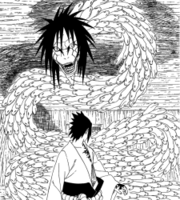
The influence snakes have had on Orochimaru is most evident in the results of his immortality research: after years of study and self-modifications, Orochimaru’s “true” form has become that of a giant white snake that is composed of many smaller snakes. To live forever and escape death, Orochimaru first finds a new body that will act as his own. He then leaves the confines of the body he is inhabiting, revealing his true form. Once doing so, Orochimaru needs only to consume the new body and gain dominance over the soul of its current inhabitant, thus gaining complete control and access to all the body’s unique abilities. While inhabiting this body, Orochimaru typically wears a mask of his original face, it being both his personal preference and easier for others to communicate with someone they recognize. Orochimaru can only perform this body-transfer once every three years, at which point in time weaker bodies begin to reject him and therefore necessitate he find a new body.

Orochimaru acts as the primary antagonist for the first part of the series, planning the invasion and eventual destruction of Konoha so that he can kill the Third Hokage and gain the body of Itachi Uchiha’s brother, Sasuke Uchiha. When the Third is able to fight back during their battle and take away Orochimaru’s ability to perform jutsu, he is forced to put his plans for Sasuke on hold, calling off Konoha’s invasion and pulling his forces back. Wanting to regain the ability to use jutsu, Orochimaru seeks out a way to cure himself. When all his efforts prove unsuccessful, Orochimaru sends his Sound Four to fetch Sasuke, hoping that a body-transfer will undo the Third’s seal. Though he waits as long as he can, Sasuke takes too long to arrive and Orochimaru is forced to switch to the body of one of his prisoners instead. Once Sasuke arrives, Orochimaru begins molding him into the ideal body, coveting the day that he will be able to take the body for himself.

Two-and-a-half years later, in the second part of the series, Orochimaru prepares to take Sasuke’s body. Sasuke, unwilling to give himself up to Orochimaru, fights an attempted body-switch. Having the stronger will, Sasuke retains control of his body while trapping Orochimaru’s soul within him, giving him access to many of Orochimaru’s abilities in the process. In the aftermath of Orochimaru’s defeat one of his subordinates, Kabuto Yakushi, absorbs his remains, which have since begun to slowly take over Kabuto’s body. During Sasuke’s later fight with Itachi, Sasuke is left too weak to continue suppressing Orochimaru’s spirit, allowing Orochimaru to escape and try to take his body again. Before he can do so, Itachi traps him in an inescapable dream-like realm, robbing Orochimaru of his chance to gain the Sharingan and releasing Sasuke from his influence.

Orochimaru so far has only appeared in the most recent Naruto film, Naruto Shippūden 2: Bonds. He is not present in the other four films in the series, nor any of the original video animations; however, is a playable character in nearly all Naruto video games, including the Clash of Ninja series and the Ultimate Ninja series. In some games, he utilizes variations of his techniques not seen in the anime or manga, and in the second installment of the Ultimate Ninja series, his state after his arms were sealed by the Third Hokage is available as a separate character. Naruto Shippūden: Gekitou Ninja Taisen EX 2 marks the first appearance of Orochimaru in a video game set in Part II, with the second one being Naruto Shippūden: Narutimate Accel 2.

Orochimaru has been featured consistently in the Shonen Jump popularity polls, commonly placing in the top twenty characters. The last such poll was in 2006, in which Orochimaru was in 24th place. Merchandise based on Orochimaru has also been released, including action figures, plush dolls, and key chains.

Several publications for manga, anime, video games, and other related media have provided praise and criticism on Orochimaru’s character. IGN compared Orochimaru’s search for power and subsequent fall into villainy to that of Darth Vader, and labeled Orochimaru as “something more than just pure evil.” Mania.com considered Orochimaru the “first real villain” of the series, noting that he had no redeeming qualities, as versus Zabuza Momochi, the villain of the previous arc. DVDTalk celebrated the introduction of Orochimaru into the series, as well as the potential plot development from the curse seal Orochimaru placed on Sasuke, noting it was one of the best parts of the series. Instead, Anime News Network labeled Orochimaru to be a character that can not be killed. However, they considered Kujira, Orochimaru’s Japanese voice actor, as one of the best ones from the series.
read more...